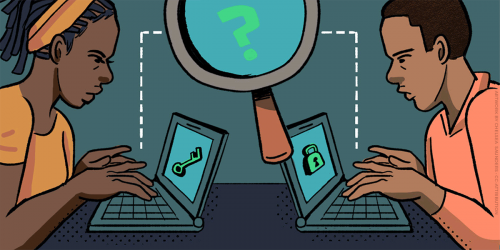
When it comes to keeping our texts, chats, and other digital messages safe from prying eyes, we have a powerful tool: end-to-end encryption. Used correctly, end-to-end encryption turns our conversations online into secret messages that can only be decoded by their intended recipients. In our latest EFFector newsletter, we're...
For years, civil society organizations, workers, journalists, and human rights experts have warned that major technology companies risk enabling grave human rights abuses when they provide cloud computing, AI, and surveillance infrastructure to governments implicated in violations of international and humanitarian law. While many companies pay lip service to evaluating...
Corporations bear responsibility for violating user trust and human rights, and EFF is holding them accountable with your support. We’ve seen collective action rein in companies and bring them back on track to protect users. With you by our side, we can do it again.
Banned for decades for its unvarnished depiction of state surveillance, The Ear unfolds over one sleepless night when a couple discovers that “the ear” of the Communist regime is listening in on their every word.Get Tickets TodayAlready on edge in the wake of an ongoing Communist purge, a government...
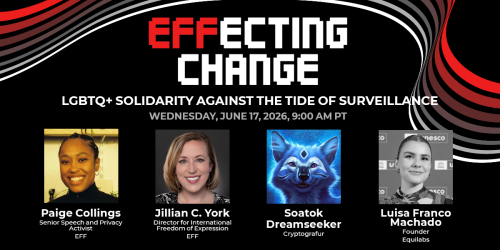
This event has passed. You can watch the recording on YouTube or the Internet Archive.LGBTQ+ communities are facing an escalating wave of censorship and targeted surveillance, but we can push back through mutual solidarity. Join us live to learn how safer virtual...
We recently updated our privacy policy for the first time since 2022. Most of the changes are clarifications, reorganizations, and improvements in transparency, particularly around how third-party tools that run parts of our site operate. But one change is substantive enough that we want to address it directly.The Change You...
Poor accountability, feeble control mechanisms, and insufficient legal frameworks have led to systematic human rights violations in the Americas, with no consistent remedy or reparation to victims. What's needed is to materialize essential guarantees and measures to combat repeated surveillance abuses in the region. To help build a path...
EFF will be back in Las Vegas, NV for Black Hat USA! We're excited to be in the Business Hall during the Briefings portion of the conference, where you can come say hi and learn more about the work we are doing to defend digital freedoms. You can even...
EFF's Privacy Badger blocks the hidden trackers that twist your web browsing into a commodity for Big Tech, advertisers, scammers, and data brokers. But did you know that we’re trying to solve an issue that’s even bigger than creepy ads and user profiling? You can help.
As statehouses ramp up for 2026, we’re seeing a familiar and concerning trend of lawmakers rushing to regulate the internet based on shockingly shaky science. From the California State Assembly to the Massachusetts and Minnesotalegislatures, a wave of bills is crashing against the digital lives...
Last week, Instagram ended its opt-in, and therefore rarely used, end-to-end encryption feature. Years after publicly promising to provide the privacy protections of end-to-end encryption across its platforms by default, it instead gave up on that technical challenge. Now, we've all lost an option for safer...
Osama Khalid was just twelve years old when he began contributing to Wikipedia Arabic. In the height of the blogging era, he became a prolific blogger, publishing writings on his home country of Saudi Arabia, meetups he attended, and his opinions and observations about open source technology and freedom of...
Internet shutdowns are devastating for human rights. We can’t rely on tech oligarchs to save us, especially when these same companies and governments are the ones to sever our access to the internet and telecommunications. This is why it's important to set up communication mechanisms before a disaster happens.
Last year, Canada's Bill C-2 was so bad it didn’t even make it to committee because of the backlash from the privacy community. Now, the spring’s worst sequel, Bill C-22, aka The Lawful Access Act, is trying it again.